Jiang Yanhua
School of Design and Art, Hunan Institute of Applied Technology, Changde City, Hunan Province, China
e-mail: myhearthuahua11@163.com
Abstract:With the rapid development of interdisciplinary education and innovative talent training in higher education, non-art major students generally face prominent dilemmas such as rigid thinking modes, insufficient psychological adjustment ability, and single problem-solving logic in their academic study and social adaptation. Design thinking, as a human-centered, iterative and innovative thinking paradigm, has unique intervention value in cultivating students’ comprehensive psychological quality and practical ability. This study aims to explore the specific intervention effect of systematic design thinking training on the psychological resilience and problem-solving ability of non-art major students, and to clarify the internal mechanism and practical application value of design thinking education in general higher education. A total of 120 non-art major students from comprehensive universities were selected as research subjects, and they were randomly divided into an experimental group and a control group, with 60 students in each group. The experimental group received an 8-week standardized design thinking training intervention, while the control group maintained conventional daily teaching arrangements without additional intervention. Psychological Resilience Scale and Student Problem-Solving Ability Scale were used for pre-test and post-test data collection, and independent sample t-test, paired sample t-test and correlation analysis were adopted for data processing. The research results show that after design thinking training, the scores of psychological resilience and each dimension, as well as problem-solving ability and each dimension of the experimental group are significantly higher than those of the control group; design thinking training has a significant positive predictive effect on the improvement of students’ psychological resilience and problem-solving ability; psychological resilience plays a partial mediating role between design thinking training and problem-solving ability. This study confirms the positive intervention value of design thinking training for non-art major students, provides empirical basis for popularizing design thinking interdisciplinary training in higher education, and offers new ideas for optimizing the comprehensive quality training system of non-art major students.
Keywords: Design Thinking Training; Non-Art Major Students; Psychological Resilience; Problem-Solving Ability; Intervention Effect
1.1 Research Background: Educational Reform Calls for Innovative Quality Cultivation
In the context of global educational transformation and innovative talent-driven development strategy, higher education has shifted its core training goal from professional knowledge indoctrination to comprehensive innovative quality cultivation. Modern social development puts forward higher requirements for college students’ adaptive ability, anti-frustration ability and practical problem-solving ability. Different from art major students who receive long-term innovative thinking and divergent thinking training in professional learning, non-art major students majoring in science, engineering, liberal arts and economics have long been immersed in standardized, logical and convergent thinking training systems[1]. Their thinking modes are relatively fixed, and they are prone to negative psychological states such as anxiety, confusion and self-doubt when facing learning difficulties, environmental changes and unexpected problems, resulting in low psychological resilience and single problem-solving strategies.
Psychological resilience refers to the positive psychological quality that individuals can quickly adjust, recover and grow in the face of pressure, setbacks and adversities, which is an important core index to measure students’ mental health and adaptive development. Problem-solving ability is a comprehensive practical ability that integrates cognitive judgment, logical analysis, innovative thinking and practical operation, which directly determines students’ academic development and future social adaptation level[2-4]. At present, most colleges and universities carry out quality expansion training for non-art major students focusing on professional ability and ideological education, while there are relatively few targeted intervention training for innovative thinking, psychological resilience and problem-solving literacy, and the training effect is lack of systematic empirical verification.
Design thinking originated from industrial design discipline, and has gradually developed into a universal innovative thinking and problem-solving paradigm with the core of empathy, definition, ideation, prototyping and testing. It breaks the single logical thinking limitation of traditional discipline education, emphasizes human-centered demand orientation, iterative innovation and trial-and-error optimization, and can effectively make up for the deficiencies of rigid thinking and insufficient innovative practice in non-art major education. In recent years, design thinking has been widely applied in the field of higher education teaching reform, but most existing studies focus on teaching model innovation and professional ability improvement, and few focus on the intervention effect of design thinking training on students’ psychological quality and comprehensive problem-solving ability, especially the targeted research for non-art major students is still insufficient. Therefore, it is of great theoretical and practical significance to carry out empirical research on the intervention effect of design thinking training on non-art major students’ psychological resilience and problem-solving ability[5].
1.2 Research Significance: Theoretical Innovation and Practical Application Complement Each Other
In terms of theoretical significance, this study systematically verifies the causal relationship between design thinking training and the improvement of non-art major students’ psychological resilience and problem-solving ability, expands the application boundary of design thinking theory in general higher education, and enriches the theoretical research system of college students’ psychological quality intervention and innovative ability cultivation. Most previous studies on design thinking education take art majors or all college students as research objects, and lack targeted exploration for non-art major groups with relatively fixed thinking modes. This study focuses on non-art major students, clarifies the differentiated intervention effect of design thinking training on different student groups, and makes up for the research gap in the field of interdisciplinary innovative education for non-art majors[6-8]. At the same time, this study explores the mediating mechanism of psychological resilience between design thinking training and problem-solving ability, which deepens the theoretical understanding of the internal action path of innovative thinking training on students’ comprehensive ability development.
In terms of practical significance, this study provides a feasible and standardized training scheme for colleges and universities to carry out innovative quality training for non-art major students. Through empirical verification of the significant intervention effect of design thinking training, it can promote colleges and universities to break the discipline barrier of design education, popularize design thinking interdisciplinary training courses, and optimize the talent training system for non-art majors. For non-art major students, systematic design thinking training can help them break the shackles of fixed thinking, improve their ability to cope with setbacks and pressure, form diversified problem-solving strategies, and lay a solid foundation for their academic innovation and future career development. In addition, the research conclusions can also provide reference for primary and secondary school innovative quality education, and promote the whole-stage optimization of innovative talent training in basic education and higher education.
1.3 Research Objectives and Research Hypotheses
The core research objectives of this study are divided into three levels: first, to analyze the current situation of psychological resilience and problem-solving ability of non-art major students, and explore the overall characteristics and existing problems of their psychological quality and practical ability; second, to verify the intervention effect of 8-week standardized design thinking training on non-art major students’ psychological resilience and problem-solving ability, and compare the differences of each dimension before and after the intervention; third, to explore the correlation and internal mechanism among design thinking training, psychological resilience and problem-solving ability, and clarify the action path of design thinking training affecting students’ problem-solving ability.
Based on existing literature and theoretical analysis, the research hypotheses of this study are put forward as follows: H1: Design thinking training can significantly improve the overall level and each dimension of psychological resilience of non-art major students; H2: Design thinking training can significantly enhance the overall level and each dimension of problem-solving ability of non-art major students; H3: There is a significant positive correlation between psychological resilience and problem-solving ability of non-art major students; H4: Psychological resilience plays a mediating role between design thinking training and problem-solving ability of non-art major students.
2.1 Research Status of Design Thinking Training in Higher Education
Design thinking is a systematic innovative thinking method proposed by Stanford University d.school, which takes “human empathy, problem definition, brainstorming, prototype design, iterative testing” as the core process, and emphasizes the integration of user demand, innovative imagination and practical operation. Foreign research on design thinking education started early, and many top universities have set up special design thinking training courses and laboratories, covering interdisciplinary fields such as engineering, management, liberal arts and medicine. Relevant foreign studies have confirmed that design thinking training can effectively cultivate students’ innovative consciousness, collaborative ability and practical operation ability, and help students form positive exploratory thinking habits.
Domestic research on design thinking education has developed rapidly in recent years, with the continuous promotion of interdisciplinary education reform. Most domestic studies focus on the application of design thinking in curriculum teaching reform, such as the optimization of professional course teaching mode, the innovation of practical teaching system, and the cultivation of students’ professional innovative ability. Some studies have pointed out that design thinking can break the closed state of single discipline teaching, stimulate students’ autonomous learning motivation and innovative thinking potential. However, most of the existing domestic studies take teaching reform and curriculum innovation as the core, and lack empirical research on the intervention effect of design thinking training on students’ psychological quality. Moreover, the research objects are mostly general college students or art majors, and there are few targeted studies on non-art major students with relatively weak innovative thinking foundation, which leads to the lack of pertinence and comprehensiveness of the research conclusions.
2.2 Research Status of College Students’ Psychological Resilience Intervention
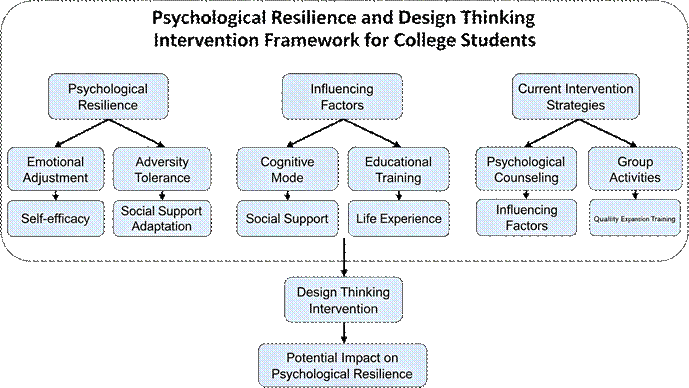
Psychological resilience is a positive psychological resource for individuals to cope with adversity, and its core dimensions include emotional adjustment, adversity tolerance, self-efficacy and social support adaptation. At present, domestic and foreign research on college students’ psychological resilience mainly focuses on influencing factors and intervention strategies. Existing studies have confirmed that individual cognitive mode, social support, educational training and life experience are the key factors affecting college students’ psychological resilience. In terms of intervention measures, most colleges and universities carry out psychological counseling, group psychological activities and quality expansion training to improve students’ psychological resilience, but most of these intervention methods are passive emotional guidance, lacking active thinking training and ability shaping.
In recent years, some studies have begun to explore the relationship between innovative thinking training and psychological resilience, pointing out that positive innovative thinking practice can help students accumulate successful experience, enhance self-confidence and emotional adjustment ability, and thus improve psychological resilience. However, there are few studies taking design thinking as an intervention means to explore its effect on psychological resilience of non-art major students, and the intervention mechanism and training effect need further empirical verification.
2.3 Research Status of College Students’ Problem-Solving Ability Cultivation
Problem-solving ability is a comprehensive ability system including problem recognition, scheme design, logical analysis, practical implementation and effect evaluation, which is the core ability of college students’ academic development and social adaptation. Traditional college education for non-art majors focuses on the cultivation of logical reasoning and knowledge memory ability, and ignores the training of divergent thinking, innovative trial-and-error and practical problem-solving ability, resulting in many students having rigid problem-solving ideas, single coping strategies, and difficulty in dealing with complex and uncertain problems.
Existing studies have shown that innovative thinking training, interdisciplinary practice and exploratory learning can effectively improve students’ problem-solving ability. Design thinking, as a problem-oriented innovative thinking paradigm, takes solving practical problems as the core goal, and its whole process of demand analysis, scheme innovation, prototype trial production and iterative optimization is highly consistent with the cultivation logic of problem-solving ability. However, the current research on the relationship between design thinking and problem-solving ability mostly stays in theoretical analysis, lacking empirical data support, and there is no systematic research on the differentiated improvement effect of design thinking training on each dimension of problem-solving ability of non-art major students.
2.4 Research Review and Deficiencies
To sum up, the existing studies have confirmed the positive value of design thinking education, psychological resilience intervention and problem-solving ability cultivation respectively, and laid a certain theoretical foundation for this study. However, there are still obvious research deficiencies: first, the research objects are not targeted enough, lacking special research on non-art major students with relatively fixed thinking modes; second, the research perspective is single, most studies focus on the improvement of professional ability, and lack systematic exploration of the intervention effect on psychological quality and comprehensive problem-solving ability; third, the research method is relatively simple, most are theoretical analysis and case discussion, lacking empirical verification with standardized experimental design and data analysis; fourth, the internal mechanism of action is unclear, and the correlation and mediating relationship between design thinking training, psychological resilience and problem-solving ability have not been clarified. Based on the above research deficiencies, this study adopts experimental research method to carry out systematic empirical research, so as to make up for the gaps in existing research.
This study adopts the random sampling method, selecting 120 undergraduate students from a comprehensive university in eastern China as research subjects, covering majors of science, engineering, liberal arts, economics and management, excluding art and design majors. All subjects have no prior design thinking learning experience and innovative thinking professional training experience, and have normal mental state and no psychological diseases through psychological screening. The subjects are randomly divided into experimental group and control group, with 60 students in each group. In the experimental group, there are 32 male students and 28 female students, with an average age of 20.35±1.26 years old; in the control group, there are 30 male students and 30 female students, with an average age of 20.18±1.32 years old. Independent sample t-test and chi-square test show that there is no significant difference in age, gender, grade and major distribution between the two groups (P>0.05), which indicates that the two groups of subjects are comparable and meet the experimental research conditions.
3.2.1 Psychological Resilience Scale
This study adopts the Chinese revised version of Connor-Davidson Psychological Resilience Scale (CD-RISC), which has good reliability and validity in the research of college students’ psychological quality. The scale includes 25 items, covering four core dimensions: emotional adjustment, adversity tolerance, self-efficacy and social adaptation. The Likert 5-point scoring method is adopted, with 1 point for “completely inconsistent” and 5 points for “completely consistent”. The higher the total score and dimension score, the higher the level of individual psychological resilience. In this study, the Cronbach’s α coefficient of the scale is 0.892, which indicates that the scale has good internal consistency reliability.
3.2.2 Student Problem-Solving Ability Scale
The self-compiled Student Problem-Solving Ability Scale is adopted in this study on the basis of sorting out existing literature and combining the characteristics of college students’ learning and life. The scale includes 22 items, covering four dimensions: problem recognition ability, scheme design ability, practical implementation ability and iterative optimization ability. The Likert 5-point scoring method is adopted, with 1-5 points corresponding to different conformity degrees. The higher the score, the stronger the individual problem-solving ability. In this study, the Cronbach’s α coefficient of the scale is 0.876, and the validity test shows that the scale has good structural validity and can effectively measure college students’ problem-solving ability level.
3.3 Experimental Intervention Scheme
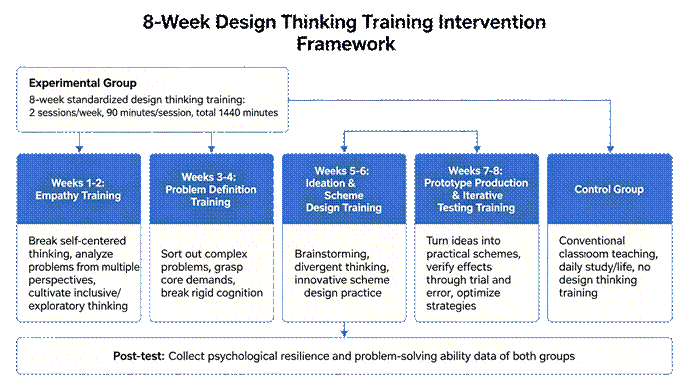
The experimental group received an 8-week standardized design thinking training intervention, with 2 training sessions per week and 90 minutes per session, totaling 1440 minutes of systematic training. The training strictly follows the five core links of design thinking, and sets phased training objectives and practical tasks according to the cognitive characteristics of non-art major students, avoiding professional design knowledge threshold, focusing on thinking mode training and ability shaping[9]. The specific training content is as follows: the first 2 weeks focus on empathy training, guiding students to break self-centered thinking, learn to analyze problems from multiple perspectives, and cultivate inclusive and exploratory thinking awareness; the 3rd-4 weeks focus on problem definition training, teaching students to sort out complex problems, grasp core demands, and break rigid problem cognition; the 5th-6 weeks focus on ideation and scheme design training, carrying out brainstorming, divergent thinking training and innovative scheme design practice to expand students’ problem-solving ideas; the 7th-8 weeks focus on prototype production and iterative testing training, guiding students to turn innovative ideas into practical schemes, verify effects through trial and error, and optimize problem-solving strategies.
During the whole training period, the control group maintains conventional classroom teaching, daily study and life arrangements, without receiving any design thinking related training and innovative thinking intervention. After the 8-week intervention, the post-test data of psychological resilience and problem-solving ability of the two groups of subjects were collected uniformly.
All valid data collected in this study are sorted out and input into SPSS 26.0 statistical software for processing. The specific analysis methods include: descriptive statistical analysis to clarify the overall level of students’ psychological resilience and problem-solving ability; paired sample t-test to compare the differences of each index of the two groups before and after the intervention; independent sample t-test to compare the difference of intervention effect between the experimental group and the control group; Pearson correlation analysis to explore the correlation between psychological resilience and problem-solving ability; mediating effect test to verify the internal mechanism of the three variables.
4. Research Results and Analysis
4.1 Baseline Level Analysis of Two Groups Before Intervention
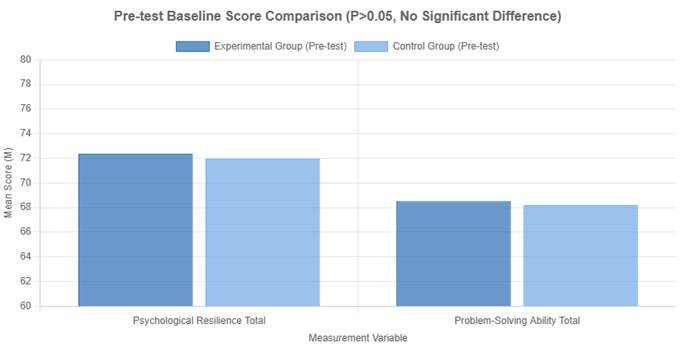
Before the formal intervention, pre-test data of psychological resilience and problem-solving ability of the experimental group and the control group were collected respectively, and independent sample t-test was carried out to verify the baseline consistency of the two groups. The specific data results are shown in Table 1.
| Variable | Dimension | Experimental Group (M±SD) | Control Group (M±SD) | t | P |
| Psychological Resilience | Total Score | 72.36±8.52 | 71.98±8.65 | 0.246 | 0.806 |
| Emotional Adjustment | 18.25±3.12 | 18.12±3.08 | 0.198 | 0.843 | |
| Adversity Tolerance | 17.68±2.95 | 17.54±3.02 | 0.252 | 0.801 | |
| Self-Efficacy | 18.42±3.26 | 18.35±3.19 | 0.121 | 0.904 | |
| Social Adaptation | 18.01±3.05 | 17.97±3.11 | 0.072 | 0.943 | |
| Problem-Solving Ability | Total Score | 68.52±7.86 | 68.21±7.92 | 0.215 | 0.830 |
| Problem Recognition | 17.35±2.86 | 17.28±2.91 | 0.134 | 0.894 | |
| Scheme Design | 16.89±2.75 | 16.82±2.80 | 0.142 | 0.887 | |
| Practical Implementation | 17.12±2.93 | 17.05±2.89 | 0.116 | 0.908 | |
| Iterative Optimization | 17.16±2.82 | 17.06±2.85 | 0.158 | 0.875 |
As shown in Table 1, before the intervention, there is no significant difference in the total score and each dimension score of psychological resilience and problem-solving ability between the experimental group and the control group (all P>0.05). It indicates that the psychological quality and problem-solving ability level of the two groups of subjects are basically consistent before the experiment, the sample baseline is balanced, and the experimental research can be carried out normally.
4.2 Intervention Effect on Psychological Resilience of Non-Art Major Students
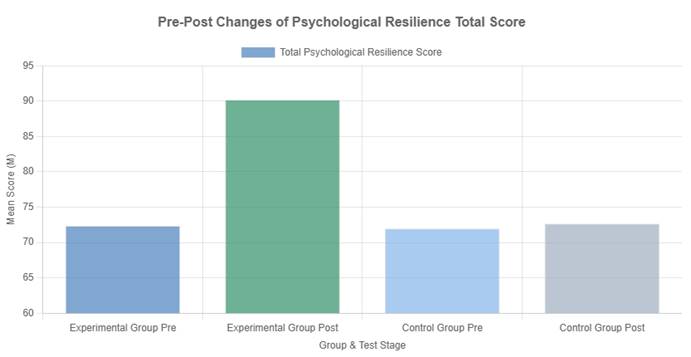
After 8-week design thinking training intervention, the post-test data of psychological resilience of the two groups were collected, and paired sample t-test and independent sample t-test were used to analyze the changes of psychological resilience level of the two groups before and after the intervention. The specific results are shown in Table 2.
| Dimension | Group | Pre-test (M±SD) | Post-test (M±SD) | t | P |
| Emotional Adjustment | Experimental Group | 18.25±3.12 | 22.68±2.85 | 8.965 | <0.001 |
| Control Group | 18.12±3.08 | 18.35±3.10 | 0.426 | 0.672 | |
| Adversity Tolerance | Experimental Group | 17.68±2.95 | 21.95±2.76 | 8.523 | <0.001 |
| Control Group | 17.54±3.02 | 17.69±2.98 | 0.315 | 0.753 | |
| Self-Efficacy | Experimental Group | 18.42±3.26 | 23.12±2.93 | 9.214 | <0.001 |
| Control Group | 18.35±3.19 | 18.51±3.22 | 0.289 | 0.773 | |
| Social Adaptation | Experimental Group | 18.01±3.05 | 22.45±2.81 | 8.876 | <0.001 |
| Control Group | 17.97±3.11 | 18.12±3.09 | 0.258 | 0.797 | |
| Total Psychological Resilience | Experimental Group | 72.36±8.52 | 90.20±7.86 | 10.352 | <0.001 |
| Control Group | 71.98±8.65 | 72.67±8.59 | 0.412 | 0.681 |
It can be seen from Table 2 that after the intervention, the total score and each dimension score of psychological resilience of the experimental group are significantly higher than those before the intervention (P<0.001), while there is no significant change in each index of the control group before and after the experiment (P>0.05). Further independent sample t-test shows that the post-test scores of all psychological resilience dimensions of the experimental group are significantly higher than those of the control group (P<0.001). The results fully verify Hypothesis 1 of this study, indicating that design thinking training can significantly improve the psychological resilience level of non-art major students, and has significant positive intervention effects on emotional adjustment, adversity tolerance, self-efficacy and social adaptation of students.
The core reasons for the above results are as follows: design thinking training emphasizes positive exploratory practice and iterative trial and error, which enables students to continuously gain successful experience in innovative practice, effectively enhance self-recognition and self-efficacy; the multi-dimensional perspective analysis training of design thinking helps students learn to adjust negative emotions, improve emotional management ability when facing difficulties; the team cooperation and problem-solving practice in the training process strengthens students’ social communication and adaptive ability, and further improves their overall psychological resilience level.
4.3 Intervention Effect on Problem-Solving Ability of Non-Art Major Students
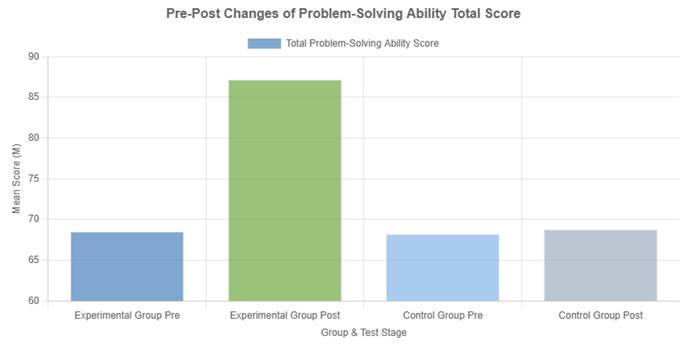
In order to verify the intervention effect of design thinking training on students’ problem-solving ability, this study compares and analyzes the changes of problem-solving ability and each dimension of the two groups before and after the intervention, and the specific data results are shown in Table 3.
| Dimension | Group | Pre-test (M±SD) | Post-test (M±SD) | t | P |
| Problem Recognition | Experimental Group | 17.35±2.86 | 21.86±2.63 | 9.125 | <0.001 |
| Control Group | 17.28±2.91 | 17.42±2.89 | 0.326 | 0.745 | |
| Scheme Design | Experimental Group | 16.89±2.75 | 21.53±2.58 | 8.987 | <0.001 |
| Control Group | 16.82±2.80 | 16.95±2.77 | 0.293 | 0.779 | |
| Practical Implementation | Experimental Group | 17.12±2.93 | 22.01±2.69 | 9.368 | <0.001 |
| Control Group | 17.05±2.89 | 17.21±2.86 | 0.305 | 0.761 | |
| Iterative Optimization | Experimental Group | 17.16±2.82 | 21.78±2.65 | 9.012 | <0.001 |
| Control Group | 17.06±2.85 | 17.19±2.83 | 0.276 | 0.783 | |
| Total Problem-Solving Ability | Experimental Group | 68.52±7.86 | 87.18±7.25 | 10.865 | <0.001 |
| Control Group | 68.21±7.92 | 68.77±7.89 | 0.389 | 0.698 |
The data in Table 3 show that after design thinking training, the total score and each dimension score of problem-solving ability of the experimental group are significantly improved compared with those before the intervention (P<0.001), while all indexes of the control group have no significant changes (P>0.05). The post-test problem-solving ability level of the experimental group is significantly higher than that of the control group, which verifies Hypothesis 2 of this study. It shows that design thinking training has a comprehensive and significant intervention effect on the problem-solving ability of non-art major students, and can effectively improve students’ ability to identify problems, design schemes, practice implementation and iterative optimization.
From the perspective of training logic, the whole process of design thinking is centered on solving practical problems. The problem definition link cultivates students’ accurate problem recognition ability; the brainstorming and scheme design links break students’ single thinking limitation and expand diversified problem-solving ideas; the prototype production and iterative testing links train students’ practical operation and continuous optimization ability. For non-art major students who lack innovative practice training, this whole-process problem-oriented training mode can effectively make up for their deficiencies in problem-solving logic and practical ability, and realize the comprehensive improvement of problem-solving literacy.
4.4 Correlation and Mediating Effect Analysis
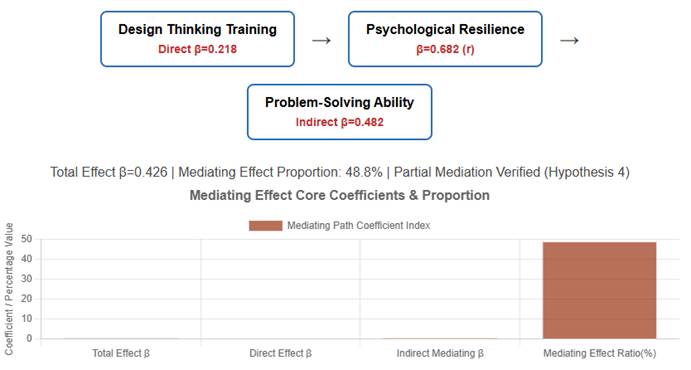
In order to explore the internal relationship among design thinking training, psychological resilience and problem-solving ability, this study firstly conducts Pearson correlation analysis on the three variables. The results show that design thinking training is significantly positively correlated with psychological resilience (r=0.682, P<0.001) and problem-solving ability (r=0.715, P<0.001); psychological resilience is significantly positively correlated with problem-solving ability (r=0.653, P<0.001), which verifies Hypothesis 3 of this study.
On the basis of correlation analysis, this study adopts the hierarchical regression method to test the mediating effect of psychological resilience. The test results show that after controlling demographic variables, design thinking training can positively predict problem-solving ability (β=0.426, P<0.001); when design thinking training and psychological resilience are included in the regression model at the same time, the positive predictive effect of design thinking training on problem-solving ability is still significant (β=0.218, P<0.01), and the predictive effect of psychological resilience on problem-solving ability is significant (β=0.482, P<0.001). It indicates that psychological resilience plays a partial mediating role between design thinking training and problem-solving ability, and the mediating effect accounts for 48.8% of the total effect, which verifies Hypothesis 4 of this study.
The mediating mechanism is clarified as follows: on the one hand, design thinking training can directly optimize students’ problem-solving thinking mode and practical strategies, and directly improve problem-solving ability; on the other hand, design thinking training improves students’ psychological resilience, enhances their emotional adjustment ability, adversity tolerance and self-confidence, enables students to maintain a positive state when facing complex problems, actively try innovative solutions, and thus indirectly improve their problem-solving ability. The dual action path of direct effect and indirect effect jointly promotes the comprehensive improvement of non-art major students’ problem-solving ability.
5.1 Direct Intervention Effect of Design Thinking Training on Psychological Resilience
This study confirms that design thinking training can significantly improve the psychological resilience of non-art major students, which is consistent with the positive view of existing innovative thinking training on psychological quality improvement. Different from traditional passive psychological intervention, design thinking training is a kind of active psychological quality shaping. The open and inclusive training atmosphere of design thinking breaks the rigid learning atmosphere of traditional professional courses for non-art majors. Students are allowed to put forward diverse ideas and trial-and-error schemes without excessive constraint of standard answers, which effectively reduces students’ learning anxiety and fear of failure.
In the iterative trial-and-error practice of design thinking training, students will experience the process of scheme design, trial production, failure adjustment and re-optimization. This process enables students to correctly recognize the normality of setbacks and failures, gradually improve their adversity tolerance, and form a positive frustration cognition. At the same time, every successful scheme optimization and problem solving in the training will accumulate positive psychological resources for students, continuously enhance their self-efficacy and emotional adjustment ability, and finally realize the overall improvement of psychological resilience. For non-art major students who are used to standardized learning, this exploratory and trial-and-error allowed training mode has a unique positive intervention effect on their psychological quality improvement[10-12].
5.2 Direct Intervention Effect of Design Thinking Training on Problem-Solving Ability
The research results show that design thinking training has a comprehensive promoting effect on each dimension of non-art major students’ problem-solving ability, which is determined by the inherent logical consistency between design thinking and problem-solving ability. Traditional professional learning of non-art majors focuses on logical deduction and knowledge application, and students are used to solving fixed problems with fixed formulas and methods, resulting in rigid problem-solving thinking and lack of innovative coping strategies for uncertain problems.
The five-stage cycle model of design thinking perfectly fits the whole process of solving complex practical problems. The empathy and problem definition links train students’ ability to accurately capture core problems from complex phenomena; the brainstorming and divergent thinking training break students’ inertial thinking, expand problem-solving dimensions; the prototype design and iterative testing cultivate students’ practical implementation and continuous optimization ability. After systematic training, non-art major students can get rid of the single problem-solving mode, form a diversified, innovative and iterative problem-solving logic, and effectively improve the comprehensive level of problem-solving ability.
5.3 Mediating Mechanism of Psychological Resilience
This study verifies the partial mediating role of psychological resilience between design thinking training and problem-solving ability, which reveals the dual action path of design thinking training affecting problem-solving ability. Design thinking training not only acts on students’ cognitive thinking level, but also shapes students’ positive psychological quality. The improvement of psychological resilience further amplifies the intervention effect of design thinking training on problem-solving ability[13].
Students with high psychological resilience have stronger emotional stability and adversity coping ability. When facing difficult and complex problems, they can maintain positive learning motivation, avoid negative emotions such as anxiety and escape, and actively invest in problem analysis and scheme innovation. On the contrary, students with low psychological resilience are easy to give up when facing setbacks, and cannot persist in innovative trial and error, which restricts the play of problem-solving ability. Therefore, design thinking training improves students’ psychological resilience, provides positive psychological support for students’ problem-solving practice, and thus promotes the better play of problem-solving ability.
5.4 Innovative Points and Practical Enlightenment of the Research
The innovative points of this research are mainly reflected in three aspects: first, the research perspective is innovative, focusing on non-art major students with weak innovative thinking foundation, breaking the limitation that existing studies mostly take art majors or general students as objects, and making the research conclusions more targeted; second, the research content is innovative, systematically verifying the intervention effect of design thinking training on psychological resilience and problem-solving ability simultaneously, and clarifying the internal mediating mechanism; third, the research method is innovative, adopting standardized experimental design, setting experimental group and control group for comparative analysis, and ensuring the scientificity and accuracy of the research conclusions through empirical data[14].
The practical enlightenment of the research is as follows: first, colleges and universities should break the discipline barrier of design education, popularize design thinking training courses in non-art major education, incorporate design thinking innovative training into the comprehensive quality training system of college students, and make up for the deficiency of innovative quality cultivation in traditional non-art major education; second, in the design of training courses, we should adhere to the combination of thinking training and psychological shaping, take problem-solving practice as the carrier, take psychological quality improvement as the support, and realize the synchronous improvement of students’ psychological quality and practical ability; third, teachers of non-art majors should integrate design thinking concepts into daily teaching, guide students to form innovative and iterative thinking habits, and help students improve their adaptive development ability in the changing social environment[15].
This study takes 120 non-art major college students as research subjects, adopts experimental research method to systematically explore the intervention effect and internal mechanism of design thinking training on students’ psychological resilience and problem-solving ability, and draws the following core conclusions: First, design thinking training can significantly improve the overall level and each dimension of psychological resilience of non-art major students, and has significant positive intervention effects on students’ emotional adjustment, adversity tolerance, self-efficacy and social adaptation. Second, design thinking training can comprehensively enhance the problem recognition, scheme design, practical implementation and iterative optimization ability of non-art major students, and effectively optimize students’ overall problem-solving ability. Third, there is a significant positive correlation between psychological resilience and problem-solving ability of non-art major students. Fourth, psychological resilience plays a partial mediating role between design thinking training and problem-solving ability. Design thinking training can not only directly improve students’ problem-solving ability through optimizing thinking mode, but also indirectly promote the improvement of problem-solving ability by shaping positive psychological resilience.
Although this study has achieved certain research results, there are still some limitations: first, the research sample is limited, the research subjects only come from a single comprehensive university, and the sample coverage is not wide enough, which may affect the universality of the research conclusions; second, the intervention cycle is relatively short, this study adopts an 8-week short-term training intervention, and cannot verify the long-term sustained effect of design thinking training on students’ psychological quality and ability; third, the research dimension can be further expanded, this study only focuses on psychological resilience and problem-solving ability, and does not explore the intervention effect on students’ innovative consciousness, collaborative ability and other comprehensive qualities.
On the basis of this study, future research can be expanded from three aspects: first, expand the research sample scope, select students from different types of universities and different discipline categories of non-art majors for research, and further verify and optimize the research conclusions to improve universality; second, extend the intervention cycle, set long-term tracking intervention, explore the sustained effect and delayed effect of design thinking training on students’ psychological development and ability growth; third, enrich the research content, expand the research dimensions to students’ innovative spirit, team collaboration ability and career adaptability, and comprehensively explore the comprehensive intervention value of design thinking training in non-art major talent cultivation; fourth, optimize the training scheme, formulate differentiated design thinking training courses according to the professional characteristics of different non-art majors, and improve the pertinence and effectiveness of innovative quality training.
Reference
[1]Jiang C ,Hui B ,Sun W , et al. The psychological mechanism and heterogeneity of art design students’ intention to use AI: an empirical analysis based on an integrated framework[J].Frontiers in Psychology,2026,17 1835335-1835335.
[2]Brosamle L R ,Conner J K ,Bokoch R , et al. Mindfulness, Self-Efficacy, and Mental Health Among First-Year College Art and Design Students[J].Journal of College Student Mental Health,2025,39 (3):389-403.
[3]Ümmühan Avcı. The effect of cognitive flexibility on students’ spatial visualization abilities and computational thinking skills in a three-dimensional design and coding training[J].Research in Science & Technological Education,2025,43 (3):924-950.
[4]Challiol C ,Rodriguez A ,Garrido A . Training from experiential learning’s vision to acquire Design Thinking as a thought process[J].Thinking Skills and Creativity,2025,57 101829-101829.
[5]Plessis D E G . Leadership training, design thinking and the ethics of care: Comments on Cornel du Toit[J].Verbum et Ecclesia,2025,46 (3):e1-e5.
[6]Xu J . From Drawing to Design: Thinking Transformation Training in Graphic Composition Teaching[J].Higher Education and Practice,2024,1 (6).
[7]Wieser A M ,Leitner A . Impact of Teaching Palliative Psychology with Psychodrama and Arts Therapies on Psychology Students in Klagenfurt[J].Behavioral Sciences,2023,13 (11):931-.
[8]Todd M E ,Stewart P . Guidelines for training design thinking in organizations[J].Industrial and Commercial Training,2023,55 (3):364-374.
[9]Pengju W . The impact of social support on students’ mental health: A new perspective based on fine art majors[J].Frontiers in Psychology,2022,13 994157-994157.
[10]Hayagreeva R ,Phanish P ,Jasjit S . Does design thinking training increase creativity? Results from a field experiment with middle-school students[J].Innovation,2022,24 (2):315-332.
[11]Tiansheng X ,Mengxia K ,Meng C , et al. Design Training and Creativity: Students Develop Stronger Divergent but Not Convergent Thinking[J].Frontiers in Psychology,2021,12 695002-695002.
[12]Neethu R ,Tushar C ,Ernest M , et al. Design Considerations for Long Term Non-invasive Brain Computer Interface Training With Tetraplegic CYBATHLON Pilot[J].Frontiers in Human Neuroscience,2021,15 648275-648275.
[13]D D S ,M K ,Masrurotullaily , et al. Design of PISA-liked problem which used jember fashion carnival context to train students’ analytical thinking[J].Journal of Physics: Conference Series,2020,1465 012072-012072.
[14]Feng L .Aesthetic Education under the Influence of Creative Thinking Training——To the Art Design Major, For Example[C]//Clausius Scientific Press,2020.
[15]Zhou C ,Pasumarthi K ,Liang I , et al. Using a literary and arts magazine to promote mental health and wellness among trainee healthcare professionals: lessons from a Canadian student-led project.[J].BJPsych international,2024,21 (2):32-34.