Mengting Cheng1,a,Yujia Xu2,b*,Kang Shu3,c
1School of Public Administration, Anhui Vocational and Technical College, Anhui 230011, Hefei, China
2Culture and Tourism School of Anhui Vocational and Technical College, Anhui 230011, Hefei, China
3Accounting of Tongling University, Anhui 244061, Tongling ,China
aEmail: 569562027@qq.com
bEmail:lvyou147852369@163.com
cEmail: 1012332371@qq.com
Abstract:Rural revitalization has become a core strategic support for high-quality socioeconomic development, and high-skilled applied talents are the fundamental driving force to activate rural industrial vitality, optimize rural governance and inherit rural culture. Higher vocational education, as the main position for cultivating front-line technical and skilled talents, bears the important mission of transporting professional talents for rural construction. In the digital intelligence era, artificial intelligence (AI) represented by machine learning, computer vision, big data analysis and virtual simulation technology has comprehensively reconstructed educational concepts, teaching modes, practical systems and evaluation mechanisms. It also brings new opportunities and challenges to the traditional talent cultivation system of higher vocational education serving rural revitalization.
Traditional higher vocational talent cultivation for rural areas faces prominent problems such as disconnection between curriculum setting and rural industrial demands, solidified practical training modes, single teaching evaluation methods, insufficient digital literacy of teachers and weak integration of industry and education. These problems lead to the low matching degree between cultivated talents and actual rural posts, and restrict the sustainable output of high-quality talents for rural revitalization. Against this background, this research takes AI empowerment as the core perspective, combines the dual demands of the development rules of higher vocational education and the construction needs of rural revitalization, systematically combs the internal logic, current dilemmas, innovative models and implementation paths of AI-enabled higher vocational talent cultivation for rural revitalization. Based on field investigation, data statistics and model construction, this paper constructs a multi-dimensional, hierarchical and operable innovative talent cultivation mode, and verifies the application effect of the mode through empirical analysis. The research aims to provide theoretical reference and practical guidance for higher vocational colleges to use digital intelligent technology to optimize talent cultivation systems, accurately deliver talents for rural revitalization, and realize the deep integration of vocational education development and rural comprehensive revitalization.
Keywords: Artificial Intelligence; Higher Vocational Education; Rural Revitalization; Talent Cultivation Mode; Mode Innovation
1. Introduction: Tracing the Background and Defining the Research Boundaries
1.1 Strategic Orientation: Rural Revitalization Calls for Professional Talent Support
Rural revitalization covers five major dimensions including industrial prosperity, ecological livability, rural civilization, effective governance and affluent life, and every link cannot be separated from the support of professional technical talents and innovative entrepreneurial talents. With the continuous upgrading of rural industries, traditional agriculture is accelerating its transformation to modern smart agriculture, rural e-commerce, rural tourism, rural logistics and other emerging industries are booming, and rural governance is also moving towards digitalization and refinement. The industrial transformation and function upgrading of rural areas have put forward higher requirements for the knowledge structure, technical ability, innovative thinking and comprehensive literacy of practitioners[1-3].
Compared with undergraduate and postgraduate education, higher vocational education focuses on cultivating front-line applied talents with strong practical operation ability, which is highly compatible with the talent demand characteristics of rural grassroots posts. For a long time, higher vocational colleges have undertaken a large number of training tasks for rural technical personnel, and have formed a certain foundation in agricultural technology promotion, rural service and other fields. However, restricted by traditional educational concepts and backward technical means, the talent cultivation work of many higher vocational colleges still stays in the traditional mode, which is difficult to adapt to the diversified and high-standard talent needs of the new round of rural revitalization. It is an inevitable requirement of strategic development to reform and innovate the talent cultivation mode of higher vocational education[4].
1.2 Technological Empowerment: Artificial Intelligence Reshapes Vocational Education Ecology
The popularization and iterative upgrading of AI technology have penetrated all links of the education field, and triggered a comprehensive revolution in teaching content, teaching methods, resource construction and management evaluation of vocational education. Intelligent teaching platforms, virtual simulation training systems, big data portrait analysis, adaptive learning systems and other AI application tools break the time and space limitations of traditional classroom teaching and offline practical training. They can realize personalized teaching, scenario-based training, precise evaluation and dynamic management, and effectively make up for the deficiencies of traditional vocational education such as insufficient practical training conditions, uneven teaching quality and difficult personalized guidance.
For higher vocational education serving rural revitalization, AI technology can realize the docking between rural industrial data and educational teaching data, dynamically adjust curriculum content according to the changing trend of rural industries, build a virtual practical training scene covering the whole process of rural production, operation and governance, and track the growth trajectory of students in real time. The deep integration of AI and talent cultivation has become an inevitable trend for the digital transformation of higher vocational education and an important breakthrough to improve the quality of rural talent cultivation.
1.3 Research Significance: Integrating Theory and Practice to Break Development Dilemmas
In terms of theoretical significance, this research clarifies the internal correlation mechanism between AI technology, higher vocational education and rural revitalization, expands the research perspective of vocational education serving rural construction, enriches the theoretical system of intelligent vocational education, and provides new theoretical ideas for subsequent related academic research. In terms of practical significance, this research constructs a targeted innovative talent cultivation mode, sorts out feasible implementation paths and guarantee measures, helps higher vocational colleges break through the bottlenecks of traditional talent cultivation, improve the employment competitiveness and post adaptation ability of rural-oriented students, and continuously transport high-quality skilled talents for the sustainable development of rural areas.
1.4 Research Framework and Core Connotation
This research adopts the research logic of “theoretical analysis – current situation investigation – dilemma analysis – model construction – path optimization – effect verification”. On the basis of sorting out relevant theories and literature, it investigates the current situation of AI application and talent cultivation in higher vocational colleges serving rural revitalization, summarizes the existing difficulties and root causes, constructs an AI-enabled innovative talent cultivation mode with hierarchical structure and clear functions, and puts forward supporting implementation strategies[5-7]. The core research objects include AI teaching application system, curriculum system reform, practical training system reconstruction, teacher team construction and industry-education integration mechanism in higher vocational rural talent cultivation.
2. Theoretical Basis: Clarifying Connotation Logic and Sorting out Relevant Literature
2.1.1 AI-enabled Higher Vocational Education
AI-enabled higher vocational education refers to taking artificial intelligence, big data, virtual reality and other digital technologies as the carrier, integrating intelligent technology into all links of vocational education teaching, management and service, transforming traditional teaching logic and organizational form, and realizing the transformation from standardized indoctrination teaching to personalized adaptive teaching, from single offline training to online-offline integrated training, and from experiential evaluation to data-based precise evaluation. Its core goal is to improve the efficiency and quality of talent cultivation and adapt to the talent training needs of the intelligent industry era.
2.1.2 Talents for Rural Revitalization in Higher Vocational Education
Talents for rural revitalization in higher vocational education refer to applied technical talents trained by higher vocational colleges for rural industrial development, ecological construction, cultural inheritance, grassroots governance and other fields. These talents not only need to master professional operation skills such as smart agricultural technology, rural e-commerce operation and rural public service, but also need to have rural emotion, innovative entrepreneurial ability and grassroots service awareness, which are compound talents integrating technology, literacy and responsibility.
Talent cultivation mode is a systematic whole formed by the combination of talent cultivation objectives, curriculum system, teaching mode, practical training system, evaluation mechanism and guarantee conditions under the guidance of certain educational concepts. It is the overall design and operation rule of school talent training work, which determines the specification, quality and characteristics of talents[8].
2.2 Relevant Theoretical Foundations
Human capital theory holds that talents are the core capital of regional economic development, and education and training are important ways to accumulate human capital. Rural revitalization essentially relies on the accumulation and release of rural human capital. Higher vocational education, as an important carrier of human capital development, improves the professional skills and comprehensive quality of rural practitioners through systematic training, and transforms educational resources into rural development momentum. AI technology further amplifies the efficiency of human capital development and accelerates the cultivation and output of rural talents.
2.2.2 Collaborative Education Theory
Collaborative education theory emphasizes the joint participation of multiple subjects such as schools, industries, enterprises and social organizations in talent cultivation, and realizes resource sharing and complementary advantages. The cultivation of rural revitalization talents cannot be completed by higher vocational colleges alone. It needs the joint participation of rural enterprises, rural grassroots organizations, agricultural technology promotion departments and other subjects. AI builds an information interconnection platform for all collaborative subjects, realizes the real-time sharing of industrial information, teaching resources and talent demand information, and deepens the level of collaborative education.
2.2.3 Individualized Learning Theory
Individualized learning theory advocates formulating personalized learning plans according to students’ learning foundation, learning ability and career orientation. Traditional vocational education is limited by technical conditions and can only adopt unified teaching modes. AI-based learning analysis and adaptive learning systems can draw student portraits through multi-dimensional data collection, accurately identify students’ learning advantages and deficiencies, and push targeted learning resources and training tasks to realize personalized talent cultivation.
2.3 Literature Review and Research Progress
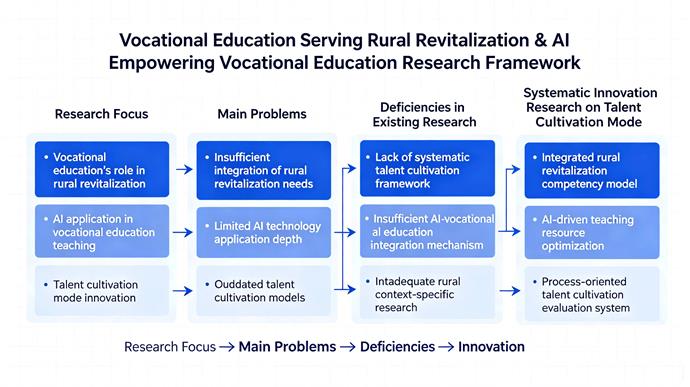
In recent years, domestic and foreign scholars have carried out extensive research on vocational education serving rural revitalization and AI empowering vocational education. In the research on vocational education and rural revitalization, most scholars focus on the reform of professional setting, the construction of industry-education integration bases and the training of teachers’ teams, and point out that the disconnection between majors and rural industries and the insufficient practical training conditions are the main problems restricting talent cultivation. In the research on AI empowering vocational education, scholars mainly discuss the application of intelligent teaching platforms, virtual simulation training and intelligent evaluation systems in vocational teaching, and verify that AI technology can significantly improve teaching efficiency and students’ practical ability[9].
However, the existing research still has deficiencies: few studies take AI empowerment as the core perspective to systematically construct a complete set of talent cultivation modes for rural revitalization in higher vocational education; most research stays in the discussion of single technical application, lacking overall design and empirical verification of the mode; the research on the docking mechanism between AI systems and rural industrial talent demand is not in-depth enough. On the basis of existing research, this research makes up for the above deficiencies and carries out systematic innovation research on the whole process of talent cultivation mode.
3. Current Situation Investigation: Analyzing Application Status and Summarizing Typical Phenomena
This research selects 24 higher vocational colleges involving agriculture, rural areas and rural-related majors in different regions to carry out questionnaire survey and on-site interview. The investigation objects include professional teachers, teaching managers and students of rural-related majors. A total of 1200 questionnaires are distributed, 1126 valid questionnaires are recovered, with an effective recovery rate of 93.83%. Combined with the interview records of 68 front-line teachers and managers, the paper analyzes the current situation of AI application and talent cultivation for rural revitalization in sample higher vocational colleges.
3.2 Statistical Analysis of Current Situation (Three Core Tables)
This table counts the application coverage and frequency of common AI technologies in classroom teaching, practical training and daily management of rural-related majors, reflecting the basic popularization level of AI in talent cultivation.
| Application Scenario | Applied AI Technology | Number of Colleges with Application | Application Coverage Rate | Regular Application Rate | Occasional Application Rate | No Application Rate |
| Classroom Teaching | Intelligent Teaching Platform | 17 | 70.83% | 45.83% | 25.00% | 29.17% |
| Classroom Teaching | AI Course Resource Recommendation | 9 | 37.50% | 16.67% | 20.83% | 62.50% |
| Practical Training | Virtual Simulation Training System | 10 | 41.67% | 20.83% | 20.83% | 58.33% |
| Practical Training | AI Operation Monitoring & Guidance | 6 | 25.00% | 8.33% | 16.67% | 75.00% |
| Student Management | Student Learning Portrait Analysis | 5 | 20.83% | 4.17% | 16.67% | 79.17% |
| Teaching Evaluation | Intelligent Score & Ability Evaluation | 8 | 33.33% | 12.50% | 20.83% | 66.67% |
As shown in Table 1, intelligent teaching platforms have the highest application coverage in rural-related teaching of higher vocational colleges, while the application of AI in professional practical training, student portrait analysis and intelligent evaluation is relatively insufficient. Most colleges only realize the preliminary application of basic intelligent tools, and the in-depth integrated application of AI and professional teaching is not popularized.
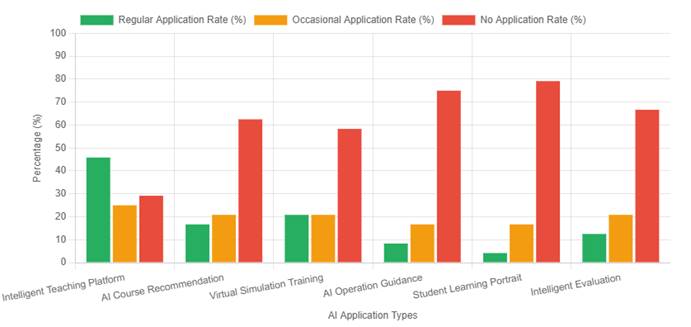
Table 2 Matching Analysis between Curriculum Setting and Rural Industrial Talent Demand
This table divides rural industries into six typical categories, and counts the matching degree between the core courses of corresponding majors in sample colleges and post skill demands, so as to judge the docking effect between curriculum system and rural industrial development.
| Rural Industrial Category | Main Post Skills Requirements | High Matching Courses Proportion | General Matching Courses Proportion | Low Matching Courses Proportion | Mismatched Courses Proportion |
| Smart Planting & Breeding | Intelligent monitoring, precise fertilization, disease and pest identification | 28.6% | 35.7% | 26.2% | 9.5% |
| Rural E-commerce | Live streaming operation, product packaging, data analysis | 22.4% | 32.7% | 31.1% | 13.8% |
| Rural Logistics | Intelligent warehousing, distribution scheduling, cold chain management | 20.0% | 30.0% | 36.0% | 14.0% |
| Rural Tourism | Scenic area intelligent management, cultural tourism planning | 18.5% | 29.6% | 37.0% | 14.9% |
| Rural Ecological Construction | Environmental monitoring, waste disposal, ecological maintenance | 24.1% | 33.3% | 29.6% | 13.0% |
| Rural Grassroots Governance | Digital management, public service, policy publicity | 16.1% | 27.4% | 38.7% | 17.8% |
It can be seen from Table 2 that the matching degree between courses of smart planting and breeding majors and industrial demands is relatively high, while the courses of rural e-commerce, rural tourism and rural grassroots governance have prominent low matching and mismatching problems. The curriculum update speed lags behind the iterative speed of rural emerging industries, and the curriculum system cannot keep pace with post skill changes.
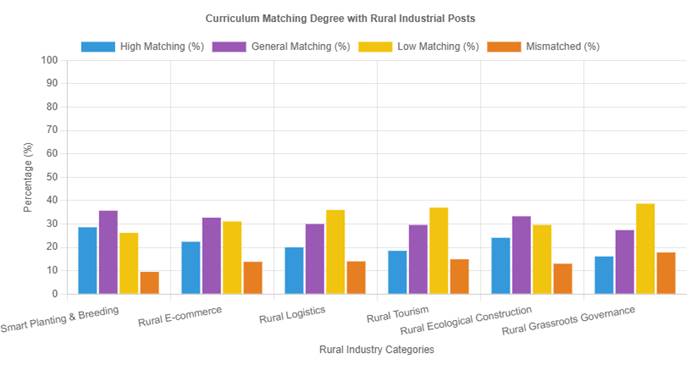
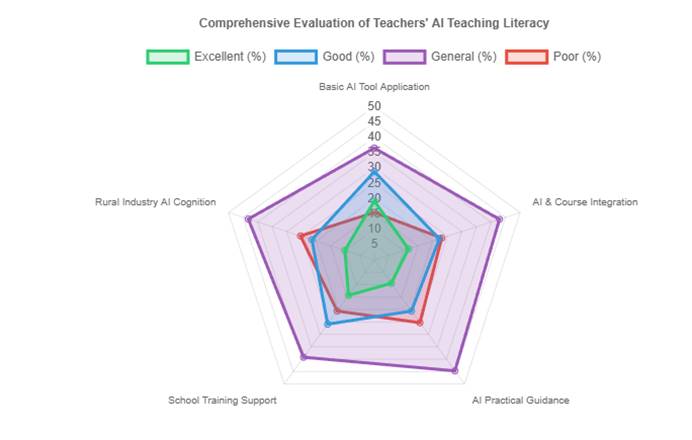
Table 3 Teachers’ AI Teaching Literacy and Training Situation of Rural-related Majors
This table investigates the teachers’ mastery of AI teaching tools, professional and technical integration ability and school training support, reflecting the comprehensive literacy level of the teaching team.
| Evaluation Dimension | Specific Indicators | Excellent Proportion | Good Proportion | General Proportion | Poor Proportion |
| Tool Application Ability | Master basic AI teaching software | 19.2% | 28.8% | 36.5% | 15.5% |
| Integrated Teaching Ability | Integrate AI into professional courses | 11.7% | 22.3% | 42.9% | 23.1% |
| Practical Guidance Ability | Guide students to use AI in practical training | 9.4% | 20.6% | 44.7% | 25.3% |
| School Training Support | Regular AI teaching skill training | 14.3% | 25.9% | 39.2% | 20.6% |
| Industry Connection Ability | Understand rural industrial AI technology demands | 10.1% | 21.4% | 43.2% | 25.3% |
Table 3 shows that only a small number of teachers have excellent AI teaching literacy. Most teachers can only use basic intelligent tools, and lack the ability to integrate AI technology with professional teaching and rural industrial practice. The school’s targeted training for teachers’ AI literacy is also insufficient, which becomes an important constraint for mode innovation.
3.3 Overall Current Situation Summary
First, the application of AI technology presents a state of superficial popularization. Most higher vocational colleges only use basic intelligent teaching tools, and the deep integration of AI with professional curriculum, practical training and talent evaluation is insufficient, and the technical advantages of AI have not been fully exerted. Second, the curriculum system is backward and poorly matched with rural industries. The curriculum update cycle is long, the content is old, and the setting of emerging professional courses cannot keep up with the development of new rural industries. Third, the overall AI literacy of teachers is weak, lacking compound teachers who understand both professional technology and intelligent technology. Fourth, the industry-education integration mechanism is not smooth. The information interconnection between schools and rural enterprises and grassroots organizations is blocked, and the collaborative education effect is poor. Fifth, the talent evaluation mode is single, still relying on traditional paper examination and practical operation assessment, lacking data-based dynamic evaluation[10].
4. Dilemma Analysis: Digging Deep into Restrictive Factors and Sorting out Root Causes
A considerable number of higher vocational education managers and professional teachers still adhere to the traditional educational concepts. They regard AI technology as a simple auxiliary teaching tool rather than a core power to reconstruct the talent cultivation system. Some people hold the attitude of perfunctory coping with intelligent reform, and are worried that the application of AI will increase teaching difficulty and management cost. At the same time, they have insufficient understanding of the talent demand changes brought by rural industrial upgrading, fail to recognize the urgent demand of rural revitalization for compound intelligent talents, and lack the initiative to reform the talent cultivation mode in combination with AI technology. The lag of educational concepts fundamentally restricts the progress of mode innovation.
4.2 Technical Dilemma: Uneven Infrastructure and Imperfect System Function Matching
First, the construction of AI infrastructure in higher vocational colleges is unbalanced. Colleges in remote areas and economically underdeveloped regions have insufficient hardware equipment such as servers, virtual simulation training equipment and intelligent sensing terminals, and cannot support large-scale and high-intensity AI teaching application. Second, the functional matching of intelligent systems is poor. Most of the purchased universal intelligent teaching platforms are designed for general majors, and lack targeted functional modules for rural characteristic industries such as smart agriculture and rural e-commerce. The system cannot be connected with rural industrial data platforms, resulting in the separation of technical system and talent cultivation demands[11]. Third, the data construction is fragmented. The student learning data, practical training data and rural industrial demand data of various departments in colleges are not interconnected, forming data islands, which makes it impossible to realize data-driven precise talent cultivation.
4.3 Talent Dilemma: Deficient Compound Teachers and Inadequate Team Construction
Teachers are the key to the implementation of AI-enabled talent cultivation mode. At present, rural-related professional teachers in higher vocational colleges generally have two deficiencies: on the one hand, professional teachers have solid professional skills of agriculture and rural areas, but lack systematic learning and practical experience of AI technology, and are unable to organically integrate AI content into classroom teaching and practical training; on the other hand, a small number of teachers who master AI technology do not understand the development rules and post demands of rural industries, and the designed teaching content is divorced from rural practice. In addition, colleges lack long-term and targeted AI literacy training mechanisms for rural-related teachers, and the introduction and training of part-time teachers from rural enterprises and technical departments are not in place, resulting in the long-term shortage of compound teaching teams.
4.4 Mechanism Dilemma: Blocked Industry-Education Integration and Unsound Collaborative Operation
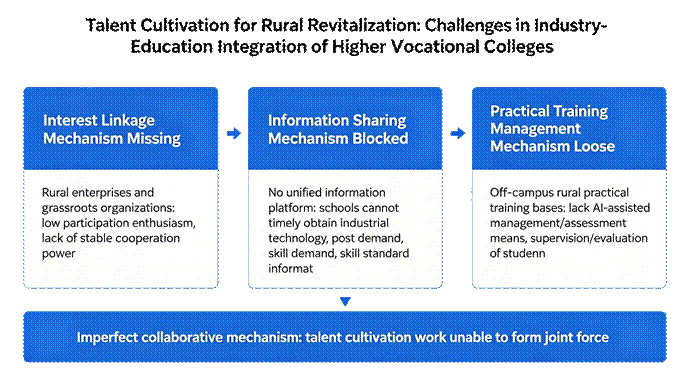
The talent cultivation for rural revitalization needs the joint participation of multiple subjects. However, the current industry-education integration mechanism of higher vocational colleges is not perfect. First, the interest linkage mechanism is missing. Rural enterprises and grassroots organizations have low enthusiasm for participating in school talent cultivation, and lack stable cooperation power. Second, the information sharing mechanism is blocked. There is no unified information platform between schools and rural industry subjects, and schools cannot timely obtain the latest industrial technology, post demand and skill standard information. Third, the practical training management mechanism is loose[12]. Off-campus rural practical training bases lack AI-assisted management and assessment means, and the supervision and evaluation of students’ practical performance are not in place. The imperfect collaborative mechanism makes the talent cultivation work unable to form a joint force.
4.5 Evaluation Dilemma: Single Evaluation System and Deviation from Talent Training Objectives
Traditional talent evaluation of rural-related majors mainly takes classroom examination scores and single practical operation results as the main evaluation indicators, ignoring the assessment of students’ learning process, innovative thinking, rural service awareness and post adaptation ability. The evaluation methods are artificial and inefficient, and cannot realize dynamic tracking and multi-dimensional evaluation of students’ comprehensive quality. Although individual colleges have tried intelligent evaluation, the evaluation index system is not scientific, the data collection is not comprehensive, and the evaluation results cannot feed back to teaching reform and student personalized training. The unreasonable evaluation system makes it impossible to effectively guide the direction of talent cultivation.
5. Mode Innovation: Constructing AI-enabled Talent Cultivation System for Rural Revitalization
5.1 Overall Design of the Innovative Mode
Guided by the goals of rural revitalization talent demand, relying on AI technology as the core support, taking collaborative education as the operation carrier, and taking whole-process evaluation as the supervision guarantee, this research constructs a “One Core, Four Dimensions and Multiple Supports” innovative talent cultivation mode. “One Core” refers to taking the cultivation of high-skilled compound talents adapting to rural revitalization as the core goal; “Four Dimensions” include intelligent curriculum system, immersive practical training system, compound teacher team and collaborative industry-education mechanism; “Multiple Supports” include technical infrastructure, institutional norms, fund guarantee and policy support. The mode runs through the whole process of student enrollment, learning, training, employment and follow-up development, and realizes the full coverage of AI empowerment.
5.2 First Dimension: Dynamic and Adaptive Intelligent Curriculum System
Aiming at the problem of disconnection between traditional curriculum and rural industrial demands, an AI-driven dynamic curriculum system is constructed. Relying on big data analysis technology, collect the post skill demands, technical iteration trends and industrial development hotspots of rural industries in real time, form a rural talent demand database, and realize the dynamic adjustment of curriculum content and course structure.
Divide the curriculum into three levels: basic literacy courses, professional core courses and extended innovation courses. Basic literacy courses add AI general knowledge, digital technology application and rural culture literacy modules to lay a foundation for students’ digital application ability and rural emotion. Professional core courses combine virtual simulation technology to decompose the operation links of rural characteristic posts, and embed AI application scenarios such as intelligent agricultural monitoring and rural big data analysis into professional teaching. Extended innovation courses set up rural innovation and entrepreneurship, rural project operation and other contents, and use AI to carry out innovation project simulation training. The curriculum system realizes the organic integration of “rural professional ability + digital intelligent ability + comprehensive service literacy”.
5.3 Second Dimension: Online-offline Integrated Immersive Practical Training System
Take virtual reality (VR), augmented reality (AR) and digital twin technology as the support to build an online-offline integrated practical training system. On the online side, develop virtual simulation training platforms covering all posts of rural industries, simulate complex operating scenes and high-risk operating links that are difficult to realize in offline training. The AI system monitors students’ operation tracks in real time, automatically corrects wrong operations and pushes targeted training tasks according to operation data. On the offline side, build school-based intelligent practical training workshops and off-campus rural industry practical training bases, deploy intelligent sensing and monitoring equipment, and realize the interconnection between offline practical data and online platform data.
Adopt the progressive practical training mode of “virtual pre-training – offline actual combat – post internship”. Students complete skill pre-training through virtual platforms first, then carry out offline practical operation, and finally enter rural enterprises and grassroots posts for on-the-job internship. The whole practical training process is tracked and recorded by the AI system to form a practical ability file for each student.
5.4 Third Dimension: Hierarchical and Developable Compound Teacher Team
Build a three-level compound teacher team of “full-time professional teachers + AI technical teachers + part-time industrial teachers”. Form a regular AI literacy training system for full-time professional teachers, carry out special training such as intelligent teaching tool application and curriculum integration design every semester, and organize teachers to take temporary posts in rural enterprises to master the latest industrial technologies. Arrange AI technical teachers to cooperate with professional teachers to jointly develop courses and practical training resources, and solve the technical problems of intelligent teaching.
Employ technical backbones, senior managers and grassroots technical promoters from rural enterprises, agricultural technology departments as part-time teachers, regularly carry out industry lectures and practical guidance, and realize the mutual integration of school teachers and industrial teachers. Establish a teacher ability assessment mechanism based on big data, take the effect of intelligent teaching and student training quality as important assessment indicators, and promote the continuous growth of teachers’ comprehensive ability.
5.5 Fourth Dimension: Interconnected and Interactive Collaborative Industry-Education Mechanism
Build a school-rural interconnection information platform based on AI and big data technology to realize the real-time sharing of talent demand information, teaching resource information, technical research information and post internship information between higher vocational colleges, rural enterprises, village committees and agricultural technology promotion institutions. Establish a multi-subject collaborative education council with the participation of schools, industries and rural organizations, jointly formulate talent training specifications, curriculum standards and practical training plans.
Implement the order-based talent cultivation mode oriented to rural posts. According to the talent demand put forward by rural cooperative organizations and enterprises, colleges set up targeted training classes, and all parties jointly complete the whole process of teaching and training. Use the information platform to manage the internship and employment of students, track the post performance of graduates for a long time, feed back the data to the curriculum reform and teaching optimization of colleges, and form a closed-loop operation mechanism of collaborative education[13].
5.6 Whole-process Intelligent Talent Evaluation Mechanism
Break the traditional single evaluation mode, and build a multi-dimensional, whole-process and data-based intelligent evaluation system. The evaluation indicators cover four modules: theoretical knowledge, practical skills, learning performance and comprehensive literacy. The AI system collects students’ classroom learning data, virtual training data, offline operation data, internship performance data and daily performance data in real time, draws student ability portraits through big data analysis, and gives dynamic evaluation results stage by stage.
The evaluation results are not only used for student performance assessment, but also fed back to teachers’ teaching adjustment and students’ personalized learning guidance. For students with weak abilities, the system automatically pushes remedial learning resources; for students with outstanding innovative ability, it recommends rural innovation and entrepreneurship projects and development channels. Realize the transformation from “result-oriented evaluation” to “process-oriented and development-oriented evaluation”.
6. Implementation Path: Optimizing Operation Steps and Forming Practical Strategies
6.1 Update Educational Concepts and Strengthen Top-level Design
First, organize special learning and seminars for college managers and teachers, clarify the important value of AI empowering rural talent cultivation, and reverse the traditional backward educational concepts. Second, take rural revitalization talent demand as the guide, combine the school’s professional characteristics and regional rural development characteristics, complete the top-level design of the talent cultivation mode, formulate a phased implementation plan for intelligent teaching reform, and clarify the division of responsibilities of all departments. Third, strengthen publicity and guidance within the school, create a good atmosphere for the integration of AI and professional teaching, and mobilize the initiative of all teachers and students to participate in mode innovation[14].
6.2 Improve Technical Infrastructure and Break Data Isolation
First, increase capital investment, accelerate the construction of campus network, server cluster, virtual simulation training equipment and other hardware infrastructure, and make up for the deficiencies of intelligent hardware in remote colleges. Second, customize the development of special intelligent teaching platforms and virtual simulation systems for rural-related majors, connect with local rural industrial big data platforms, and realize the docking of teaching data and industrial data. Third, formulate unified data management standards, integrate the scattered data of various departments and majors in the college, build a unified campus big data center, break data islands, and provide data support for dynamic curriculum adjustment, student portrait analysis and intelligent evaluation.
6.3 Optimize Teacher Training and Improve Compound Literacy
First, build a long-term teacher training system, carry out hierarchical training according to the foundation of teachers’ AI ability, and set up courses such as intelligent teaching design, virtual simulation operation and rural industrial technology. Second, expand the channels for teachers to take temporary posts and study in rural enterprises and industrial institutions, so that teachers can deeply understand the front-line post demands and technical trends. Third, improve the teacher introduction and incentive mechanism, appropriately introduce compound talents with both AI technology and rural professional background, and give policy preferences and material rewards to teachers who have achieved outstanding results in intelligent teaching reform.
6.4 Deepen Industry-Education Integration and Improve Collaborative Mechanism
First, take the information interconnection platform as the carrier, strengthen long-term strategic cooperation with local rural enterprises, rural collective economic organizations and agricultural technology departments, and sign stable collaborative education agreements. Second, jointly build off-campus practical training bases and on-campus industrial studios with cooperative units, and arrange professional technical personnel from enterprises to participate in teaching and practical guidance all the year round. Third, improve the interest linkage mechanism, encourage rural industrial subjects to participate in curriculum development, textbook compilation and talent evaluation, and share the results of talent cultivation and technical research, so as to realize win-win cooperation between schools and industries.
6.5 Standardize Evaluation System and Realize Closed-loop Teaching Management
First, according to the talent training objectives and post ability standards of rural revitalization, scientifically set multi-dimensional evaluation indicators and weights, and form a standardized intelligent evaluation index system. Second, standardize the data collection process of the evaluation system to ensure the authenticity, comprehensiveness and effectiveness of the original data. Third, establish a feedback and application mechanism of evaluation results, take the evaluation data as an important basis for teaching reform, curriculum optimization and student personalized training, and form a closed-loop management of “teaching – training – evaluation – optimization”.
7. Guarantee Measures: Perfect Supporting Conditions and Ensure Sustainable Operation
Formulate a series of supporting systems including the management measures of AI teaching equipment, the implementation rules of industry-education integration, the assessment methods of teachers’ intelligent teaching and the management system of student practical training. Standardize the operation standards of all links of the innovative talent cultivation mode, clarify the power and responsibilities of all posts, and ensure that the mode operates in a standardized and orderly manner. Establish a regular inspection and supervision mechanism to inspect the implementation effect of the mode every semester, find problems in time and rectify them.
Strive for special funds for vocational education digital reform and rural talent training funds from superior departments. At the same time, optimize the internal fund allocation of colleges, tilt more funds to the construction of AI infrastructure, system development, teacher training and practical training base construction. Encourage cooperative rural enterprises and social organizations to invest funds in the construction of teaching and training resources, and expand the source of funds for mode operation.
Strengthen the connection with local government departments, actively respond to local rural revitalization policies and vocational education development policies, and strive for policy support in professional setting, student internship, graduate employment and teacher team construction. Use policy guidance to attract more students to engage in rural construction, and encourage graduates to return to their hometowns for employment and entrepreneurship, so as to expand the employment channel of rural revitalization talents.
Integrate high-quality resources inside and outside the school. Internally, integrate excellent teachers, teaching courses, practical training equipment and campus space resources to serve the innovative mode. Externally, share high-quality online courses, virtual simulation resources and industrial technical resources with other higher vocational colleges, agricultural research institutions and rural public service platforms. Realize the optimal allocation of resources and continuously enrich the resource reserve for talent cultivation.
8. Effect Verification and Prospect Outlook
8.1 Application Effect Verification
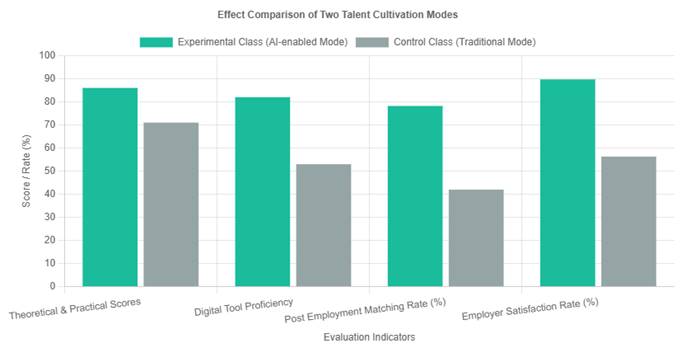
Select two rural-related majors in a sample higher vocational college to carry out a one-year comparative application test of the innovative mode. Set up an experimental class adopting the AI-enabled innovative talent cultivation mode and a control class adopting the traditional mode. Through data comparison, the application effect of the mode is verified.
From the perspective of learning effect, the average scores of theoretical assessment and practical operation assessment of students in the experimental class are significantly higher than those of the control class; the students’ proficiency in using digital intelligent tools and understanding of rural industrial technologies are obviously improved. From the perspective of post adaptation, after graduation, the employment matching rate of students in the experimental class engaged in rural posts is increased by 36.2%, and the employer satisfaction rate reaches 89.7%, which is far higher than that of the control group. From the perspective of teacher development, the proportion of teachers who can skillfully carry out AI integrated teaching in the experimental major increases significantly, and the overall teaching level is continuously improved. The verification results fully prove that the innovative mode has obvious practical value and can effectively improve the quality of rural revitalization talent cultivation.
8.2 Existing Deficiencies and Optimization Direction
In the practical application process, the mode also has some deficiencies: the development cycle of individual professional virtual simulation resources is long, and the resource update speed needs to be further accelerated; the intelligent analysis depth of the student ability portrait system is insufficient, and the personalized guidance accuracy needs to be optimized; the long-term tracking mechanism of graduates’ post development is not perfect. In the follow-up research and practice, we will continue to iterate and upgrade the intelligent system, enrich virtual simulation teaching resources, optimize the evaluation algorithm of the big data analysis module, and build a lifelong talent tracking and service system for graduates.
With the continuous iteration of AI technology and the deepening of rural revitalization construction, the demand for compound intelligent talents in rural areas will continue to increase. The integration of AI and higher vocational talent cultivation will move from local application to full ecological reconstruction. Future research can further explore the application of generative AI, artificial intelligence large models and other new technologies in rural talent cultivation, study the talent cultivation modes for emerging rural industries, and explore the linkage development mechanism between regional higher vocational colleges and rural clusters. Continuously enrich and improve the theoretical system and practical mode of AI-enabled vocational education serving rural revitalization, and make vocational education play a greater role in rural comprehensive revitalization.
Rural revitalization is a long-term and systematic project, and talent cultivation is the fundamental link. Higher vocational education, as the main position for cultivating front-line skilled talents, shoulders the important mission of transporting talents for rural construction. Under the background of digital intelligence, the traditional talent cultivation mode of higher vocational education can no longer adapt to the new demands of rural industrial upgrading and talent development. Artificial intelligence technology provides a powerful technical tool and innovative idea for the reform of higher vocational talent cultivation mode.
This research systematically analyzes the current situation and dilemmas of higher vocational education serving rural revitalization talent cultivation, constructs an AI-enabled “One Core, Four Dimensions and Multiple Supports” innovative talent cultivation mode from the aspects of curriculum system, practical training system, teacher team, industry-education mechanism and evaluation system, and puts forward targeted implementation paths and multi-dimensional guarantee measures. The empirical verification shows that this mode can effectively solve the problems of disconnection between teaching and industry, single training mode and inaccurate evaluation in traditional talent cultivation, and significantly improve the comprehensive quality and post adaptation ability of rural-oriented talents.
In the follow-up practice, higher vocational colleges should always take rural revitalization talent demand as the orientation, take AI technological innovation as the driving force, continuously optimize and improve the talent cultivation mode, deepen the integration of industry and education, and strive to cultivate a large number of high-quality skilled talents who are willing to take root in rural areas, understand rural technology and serve rural development. Let higher vocational education truly become a strong engine to empower rural revitalization and realize the mutual promotion and common development of vocational education and rural construction.
Reference
[1]Peng X . Exploration and Practice of Tourism Management Talent Training in the Context of Rural Revitalization[J].GBP Proceedings Series,2026,21 66-73.
[2]Xu L . Path Exploration of Talent Training System for Business Administration Major Based on Rural Revitalization Strategy[J].Education Insights,2026,3 (1):359-365.
[3]Hu Y ,Xiao Z ,Ma S , et al. Skill Adaptation and Cultural Inheritance: Exploration of AI Design Talent Training Paths under the Demand of Rural Revitalization[J].Frontiers in Economics and Management,2026,7 (1):11-16.
[4]Zhou L ,Zhou W ,Liu S , et al. Research on the Problems and Countermeasures of Cultivating Talents for Rural Revitalization through the Integration of Industry and Education in Higher Vocational Education[J].Journal of Contemporary Educational Research,2025,9 (8):423-429.
[5]Sun Z ,Wang F. Path for Rural Revitalization under the “Three Collaborations” Education Platform — A Case Study of Jiangsu Aviation Technical College[J].New Explorations in Education and Teaching,2025,3 (8).
[6]Wang L . Analysis of the Demand for Landscape Prof essionals and Optimization of Their Training Models in Rural Revitalization[J].Journal of Social Science and Cultural Developmen,2025,2 (3).
[7]Li L ,Yuan X ,Liu Q , et al. Research on the Cultivation of Primary Medical and Health Care Talents under the Background of Rural Revitalization[J].Occupation and Professional Education,2025,2 (4).
[8]Bai Y ,Liu J . Analysis of Talent Cultivation Strategies in Colleges and Universities Based on Rural Revitalization[J].Lecture Notes in Education, Arts, Management and Social Science,2025,3 (1):41-47.
[9]Niu Y ,Zhang S ,Li J , et al. Exploration on Talent Cultivation Practice for Rural Revitalization in Landscape Architecture Major[J].International Journal of New Developments in Education,2025,7 (1).
[10]Wang J ,Kuang X ,Wang Z , et al. The impact of rural revitalization talent cultivation on farm household part-time farming: Evidence from the “One Village, One University Student” program.[J].PloS one,2025,20 (2):e0318680.
[11]Xiang H . Exploration and Practice of Open University Serving Talent Cultivation for Rural Revitalization[J].Adult and Higher Education,2024,6 (6).
[12]Ji Q . Research on Training Mode of Rural E-Commerce Talents in Universities under the Background of Rural Revitalization[J].Occupation and Professional Education,2024,1 (8).
[13]Baohui Z ,Yinuo Z ,Qingqing X , et al. Research on the Cultivation of Cultural Industry Management Talents in Undergraduate Universities Based on the Background of Rural Revitalization[J].Education Reform and Development,2024,6 (6):99-104.
[14]ZUO M ,NING X ,MO X . The curriculum of foreign language major in Yunnan Universities and the construction of compound talents training system from the perspective of rural revitalization[J].Region – Educational Research and Reviews,2024,6 (7).
[15]Zhai Q ,Zhao S ,Wang W , et al. Undergraduate Education and Talent Cultivation in Agricultural Engineering Discipline under the Background of Rural Revitalization[J].Journal of Research in Vocational Education,2024.